What Is a DIY Klimaanlage
"Klimaanlage" is the German word for air conditioner, so a diy klimaanlage is simply a homemade air-cooling device, something you build yourself to take the edge off a hot day instead of buying a unit. The idea is popular every summer because the simplest versions cost very little and can be put together in minutes.
There are three sensible approaches, and they differ enormously in performance. The first is a fan blowing across ice, cheap, instant, and easy. The second is an evaporative cooler, which uses a fan and water and works well only in dry air. The third is a true compressor-based system, which is not something to build at home, for reasons of safety and law that this article explains.
This piece walks through all three honestly: how they work, how to build the safe ones (including a clever upgrade that makes the ice version far more effective), what to realistically expect, and why the compressor route is best left to a ready-made unit. It finishes with simple habits that keep a room cooler with no machine at all.
How Homemade Cooling Works (and Its Limits)
All cooling comes down to moving heat. Ice cools by absorbing heat from the air as it melts; evaporation cools because turning water into vapour also draws heat out of the air. A homemade cooler harnesses one of these effects and uses a fan to push the cooled air toward you.
It is important to be realistic about the limits. These devices mainly cool the airstream blowing on you, not an entire room, and the effect lasts only as long as the ice or the moisture does. They are excellent for cooling the space right next to you, on a couch or at a desk, but they will not turn a hot room into a cold one the way a real air conditioner does. Understood that way, they are genuinely useful.
The Three Sensible Approaches
Method 1: Fan and Ice
The simplest DIY klimaanlage is just a fan and a source of cold. Place ice cubes or frozen water bottles in a bowl or cooler in front of a fan, and the airstream picks up the chill and blows cooler air into the room. It costs little, needs no skill, and works the moment you switch it on.
The Upgrade: A Fan-and-Ice Cooler Box
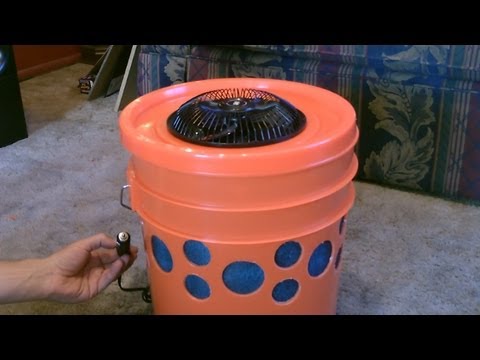
With a little more effort, the fan-and-ice idea becomes noticeably more effective. The upgrade is an insulated cooler box with a fan on top and vents on the sides, set up so the air is forced through the ice before it leaves.
- 1Cut a hole in the cooler lid just slightly larger than the fan blades, so the fan sits low and pushes air straight in.
- 2Cut two holes beside it and fit elbow pipes as the outlets, which you can spin to aim the cool air.
- 3Add downward extension pipes on the outlets so the air must travel down through the ice before rising out the vents.
- 4Fill with ice and place the fan on top.
- 5Switch on and point the vents wherever you want the cool air.
Two refinements make a real measured difference. First, forcing the air down past the ice, rather than letting it skim over the top, produces clearly colder output. Second, loose ice cubes cool better than frozen bottles, because the bottle plastic insulates the ice from the air; in tests, switching to cubes can drop the outlet temperature substantially. Some builders even suspend the ice on a small grate so air flows through it from below, squeezing out a few more degrees.
Method 2: The Evaporative Cooler
An evaporative cooler swaps ice for water. A fan blows air through a wet towel or an evaporation mat, and as the water evaporates it pulls heat from the air, lowering its temperature. It is cheap, uses no ice, and runs continuously as long as the material stays damp.
The crucial caveat is humidity. Evaporative cooling works well when the air is dry, because dry air readily takes up moisture. In humid, muggy conditions the air is already near saturation, so very little evaporation, and very little cooling, happens. If you live somewhere dry, this method shines; in sticky weather, the ice approaches will serve you better.
Method 3: The Compressor Build, and Why to Avoid It
A true air conditioner uses a refrigeration cycle with a compressor, a condenser, an evaporator, and a refrigerant gas. It is the only approach that can genuinely cool a whole room, which is why some people are tempted to build one.
This is not advisable as a home project. The reasons are serious: refrigerants are involved, the system runs under high pressure, and there are legal regulations governing their handling. Many DIY refrigerants are also flammable, and a sealed, pressurised gas circuit assembled at home carries real fire and injury risks. In practice, a ready-made portable air conditioner is usually cheaper than sourcing the parts, far more efficient, and vastly safer. If you need true room cooling, that is the route to take rather than building a compressor system yourself.
Realistic Expectations
Set against a commercial air conditioner, a DIY cooler is a comfort aid, not a climate-control system. The fan-and-ice box can blow genuinely cold air, comfortably below room temperature, and is perfect for sitting beside while you work or relax. But its reach is local and its run time is limited by how much ice you have. The evaporative cooler is steady and ice-free but tied to dry conditions. Knowing these limits up front is what keeps a DIY klimaanlage satisfying rather than disappointing: aim it at yourself, expect to cool your immediate space, and top up the ice or water as needed.
Bonus: Maximum Cooling Without a Machine
Some of the most effective cooling needs no build at all, just good habits that keep heat out and air moving.
Frequently Asked Questions
Conclusion
A DIY klimaanlage is a great way to take the sting out of a hot day without spending much. The fan-and-ice cooler is the easy win, and turning it into a sealed box with pipes that force the air down through ice cubes makes it meaningfully colder. An evaporative cooler is a fine ice-free option in dry climates, while the compressor route is best left to a ready-made unit for safety and efficiency. Pair whichever you build with smart habits, ventilating at night, shutting out the daytime sun, and aiming a fan right at yourself, and you can stay comfortably cool through summer without a costly air conditioner.