What You'll Need
I know how you feel. You've watched a dozen YouTube videos on soap making, you're excited to try it, but something's holding you back. Maybe you're worried about messing it up. Maybe the lye thing freaks you out a little.
Let me show you a simple, well-balanced recipe that's perfect for your first batch. Once you get past that first pour, you'll wonder why you waited so long.
Equipment:
- A mold that holds about 2 lbs of soap (1 liter/quart). I'm using a milk carton with the top cut off. A silicone loaf mold works great too.
- Two jugs or containers — one larger for oils, one smaller for your lye solution
- A container with a lid to measure your lye into
- A hand blender (a cheap one works fine — I've had my $10 one for over 10 years and hundreds of batches)
- Kitchen scale
- Gloves
- Safety goggles (yes, really — if you wear glasses like me, get goggles that fit over them)
- Spoons
- Paper towel and rubber band for covering the mold
Ingredients:
- 96 g sodium hydroxide (lye/caustic soda)
- 175 g water
- 70 g shea butter (or cocoa butter, mango butter, lard, or tallow)
- 140 g coconut oil
- 490 g liquid oils (olive oil, rice bran oil, sunflower, canola — mix and match)
- Optional: essential oils or fragrance oil
Step 1: Weigh Your Lye
Put your container on the scale, zero it out, and weigh 96 g of sodium hydroxide. Spoon it out of the container — don't pour. Put the lid on immediately and set it aside.
Step 2: Weigh Your Water
Weigh 175 g of water straight into your lye solution jug.
Step 3: Mix the Lye Solution
Here's the important part: always add dry lye to water, never water to dry lye. Put your goggles on. Slowly pour the lye into the water and stir. It'll get hot and give off some fumes — open a window, stand back, and stir for about 30 seconds until it dissolves. Rinse your spoon right away and set the jug aside to cool.
Step 4: Prepare Your Oils
Weigh out 70 g of shea butter and 140 g of coconut oil into your larger jug. These are solid at room temperature, so melt them gently — microwave on low power or on the stove at very low heat. Just melted, not overheated.
Now add your 490 g of liquid oils. You can use all olive oil, or mix it up with rice bran, sunflower, canola — whatever you have. If you're not confident pouring directly into the jug, weigh each oil into a separate bowl first, then add them in. I've been doing this long enough that I just zero the scale between pours, but I still managed to overpour a few grams. Don't stress about it — a few grams over just means a slightly more moisturizing soap.
Step 5: Combine and Mix
Your lye solution should still be warm. Your oils should be just slightly warm from melting the solid fats. Pour the lye solution into the oils. Scrape the jug clean and rinse it out right away.
Give it a gentle stir, then start pulsing with your hand blender. Be gentle — you don't want to splash this stuff. You'll see the color change as it starts to thicken.
You're looking for "trace" — when you drizzle batter over the surface, it leaves a trail that stays visible for a second. This recipe traces a little faster than some, so keep an eye on it.
Once you hit trace, add your essential oils if you're using them. Stir them through, then pour into your mold right away before it thickens too much.
Step 6: Mold and Insulate
Pour down the side of your mold. Give it a little tap to settle it. Smooth the top if you want, but honestly, don't worry about it being perfect — it's your first batch.
Cover the mold with a paper towel and secure it with a rubber band. Find a warm spot for it — I put mine in a cooler with a blanket. The warmth helps it saponify faster and gives it a more even texture, but it'll be fine either way. Leave it for 12-18 hours.
Step 7: Unmold and Cut
The next morning, check that it's firm. To get it out of a milk carton, cut down the sides with scissors and peel it away. Wear gloves — the soap hasn't fully cured yet and can still irritate your skin.
If any bits stick to the carton, just scrape them off and press them back onto the soap. It'll stick to itself just fine.
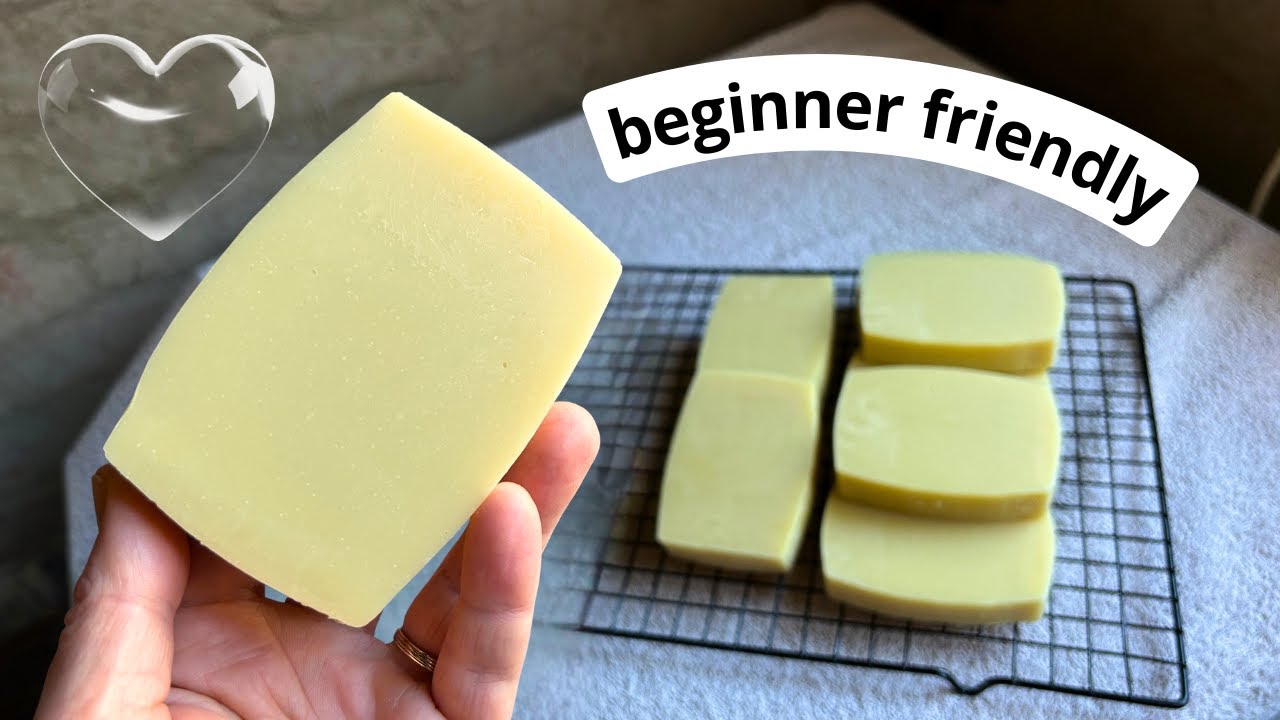
Cut your soap into bars. I get 8 bars from this recipe by cutting in half, then half again, then each piece in half. A crinkle cutter gives a nice look, but a kitchen knife works perfectly fine.
Let It Cure
Put your bars on a cooling rack and let them dry for 4-6 weeks. The soap will get harder and milder as it cures. I know waiting is the hardest part, but it's worth it.
You just made soap. Welcome to the obsession.