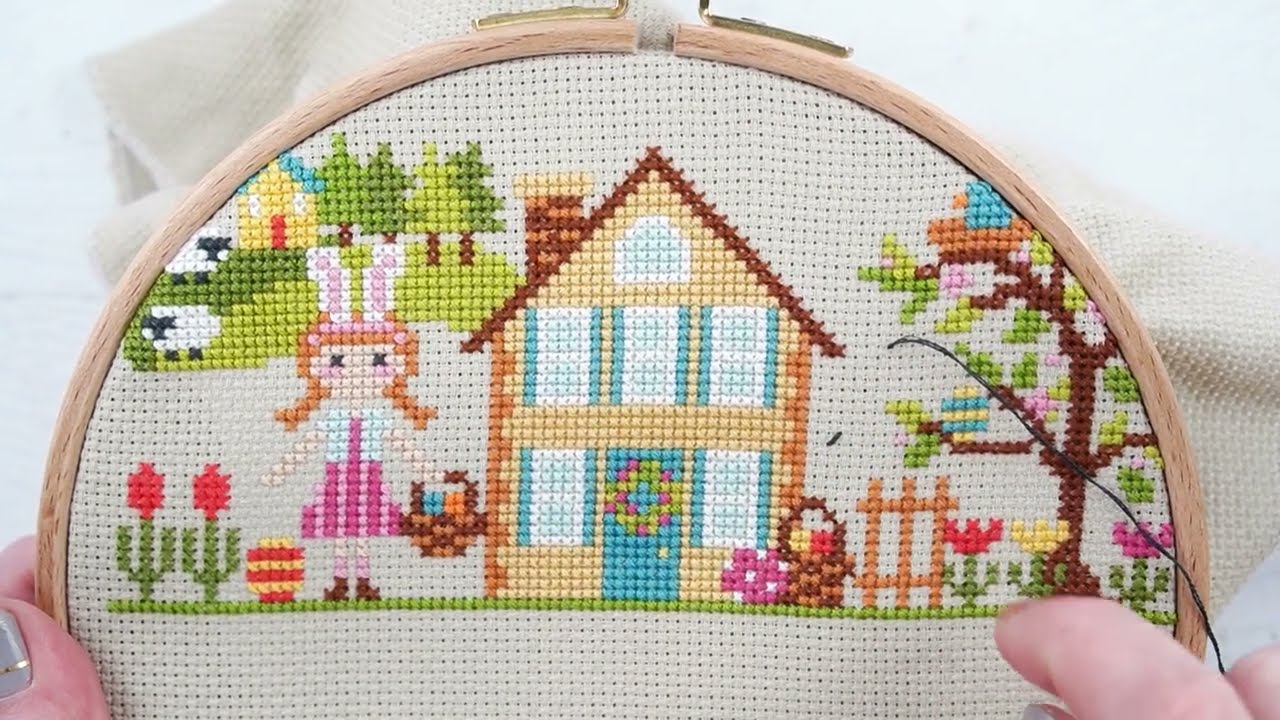
What You'll Need
Here's how to cross stitch. I'm going to walk you through it like we're sitting at the table together.
- Embroidery floss — DMC is the standard brand. Each pattern tells you the color code.
- Embroidery hoop — Wooden or plastic, whichever you like.
- Sharp embroidery scissors — Don't use your good sewing shears on this.
- Tapestry needle — Also called a cross stitch needle. The eye is big, so threading is easy.
- Aida cloth — This is the fabric with the grid of holes. You count the holes to make your X's.
- A pattern — The chart that tells you where to put each color.
About Aida Cloth
Aida comes in different "counts." That's the number of holes per inch. A 14-count fabric has 14 holes in one inch. Other common sizes are 16 and 18. The higher the number, the more holes per inch, and the smaller your finished design will be. 14-count is the most common and what I'd recommend for a beginner.
Read Your Pattern First
Your pattern is your map. Before you start, look at it. It'll tell you:
- What fabric count was used for the sample
- What stitches you need (cross stitch, back stitch, French knots)
- A chart with symbols for each color
- How many strands of floss to use for each stitch type (usually 2 strands for cross stitch, 1 for back stitch)
- How many stitches of each color you'll make
Prep Your Fabric
Aida frays like crazy. Don't skip this step.
If the edges are raw, you have two options:
- Zigzag stitch them on a sewing machine
- Fold masking tape over the raw edge
If you bought pre-cut fabric with a serged or selvage edge, you're good.
Find the Center
Fold your fabric in half, then in half again. The corner where the folds meet is the center. Stick a needle through to mark it. This is where you'll start stitching.
Your pattern also has a center marked — usually with arrows on the sides or a red line. Match those up.
Hoop Your Fabric
- Unscrew the top of the hoop
- Put the inner ring under your fabric with the center mark in the middle
- Press the outer ring down over the fabric
- Tighten the screw until it's snug but not crazy tight
- Push the fabric down so it's drum-tight in the hoop
Thread Your Needle
Pull floss from your fingertip to your elbow — that's a good working length. Cross stitch patterns usually say "2 strands." Floss comes in 6 strands twisted together. You separate them.
Pull out one strand, then another. Hold them together and thread them through your needle. Don't tie a knot.
How to Make a Cross Stitch
The Basic X
Look at your fabric. See those little holes? Four holes make a square. Your X goes corner to corner.
- Bring your needle up through the bottom-left hole of your square
- Go diagonally down through the top-right hole
- Come back up through the bottom-right hole
- Go diagonally down through the top-left hole
That's one complete X. Every single X you make should have the bottom-left to top-right stitch underneath the bottom-right to top-left stitch. Be consistent with this — it makes your finished project look clean and professional.
Securing the Thread
Since you didn't tie a knot, you need to trap the tail. Leave about an inch of thread on the back when you make your first stitch. On your second stitch, run your needle under that tail on the back of the fabric. A few stitches will hold it in place. Then snip the tail close to the fabric.
Doing a Row
If you have a line of stitches to make, don't complete each X one at a time. Do the first half of every X across the row (bottom-left to top-right for all of them), then come back and do the second half (bottom-right to top-left for all of them). This is faster and gives you a neat, consistent look.
Don't Pull Too Tight
Pull your thread until it lies flat against the fabric — not tight enough to distort the holes. If you pull too hard, your X's look skinny and the fabric puckers.
When Your Thread Gets Twisty
If your thread starts curling up, just drop your needle and let it dangle. It'll spin and untwist itself. This prevents knots.
Finishing a Thread
When you're done with a color, flip your work over. Run your needle under three or four stitches on the back — make sure you don't poke through to the front. Then snip the thread close.
What Not to Do
Don't jump across blank areas. If you have a gap between sections you're stitching, don't just run a long thread across the back. You'll see a shadow through the open fabric. Finish your thread and start a new one for the next section.
Short jumps are fine. If the distance is small and will be covered by other stitches, you can carry the thread. But keep the back neat.
Take your hoop off when you're done for the day. If you leave it hooped, you'll get a permanent crease in the fabric.
A Note on Counting
I count everything three times. I'm prone to miscounting, and you probably are too. If you can work outward from your center point, do that. If you have to count across a big empty space to find a starting point, double and triple check your numbers.
I'll be back with tutorials on back stitch and French knots — those finish off the details like words and little accents.