What You'll Need
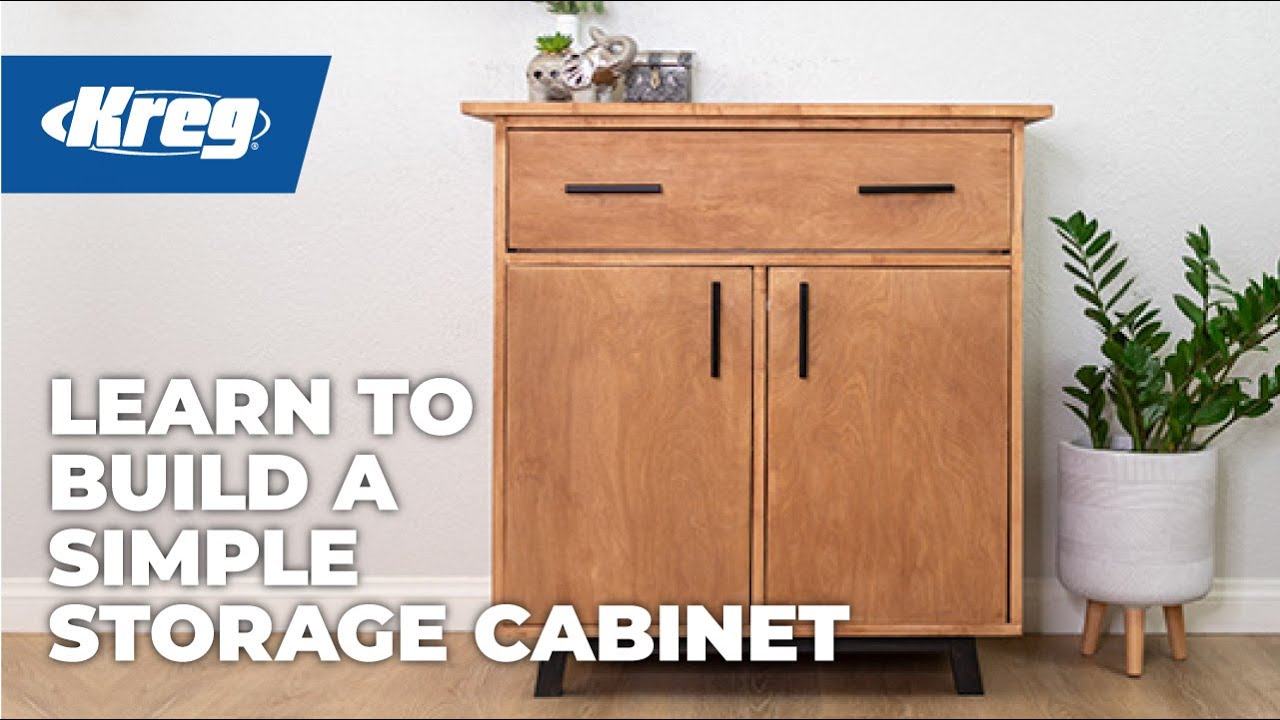
I partnered with Kreg on their YouTube channel to build this storage cabinet, and it's one of those projects that looks way more complicated than it actually is. It's built almost entirely from 3/4" plywood with just a few 2x2s for the legs. The full cut list and step-by-step plans are available on KregTool.com and in the video description.
Materials:
- 1 sheet 3/4" plywood (plus a little extra)
- 1/4" plywood for drawer bottoms
- 2x2 boards for the legs
- Edge banding (to match your plywood)
- Pocket hole screws
- Drawer slides
- Concealed hinges
- Drawer pulls
- Shelf pins
- Wood stain and top coat
Tools:
- Circular saw with rip guide (or table saw)
- Miter saw
- Kreg 720 pocket hole jig (520 or 320 works too)
- Drill/impact driver
- 90° pocket hole driver (makes life easier for tight spots)
- Orbital sander with 220 grit
- Household iron (for edge banding)
- Shelf pin jig
- Concealed hinge jig
- Hardware jig
- Quick-flip countersink bit
Step 1: Cut the Plywood
The cabinet is 18 inches deep, so a bunch of cuts are at 18 inches. I set my rip cut guide to 18" and made multiple passes without re-measuring each time. The rip cut only goes to 24", so for the 30" and 28" cuts I used a straight edge guide. For simple crosscuts I used the miter saw.
Here's what you need to cut:
- Top
- Bottom
- Two sides
- Cabinet divider
- Rails (for supporting top and drawer slides)
- Two doors
- Drawer front
I don't have a truck that fits full plywood sheets, so I get them cut down to a manageable size at the store and finish the cuts at home.
Step 2: Drill Pocket Holes
Set your drill bit collar to 3/4" for the plywood. The Kreg 720 has wings that pull out to support wider material, or you can turn it on its side for large sheets. The plans show exactly where each pocket hole goes.
One thing I learned the hard way — make sure your drill bit collar is tight. If it slips, you'll drill pocket holes in the wrong spot (you'll see my mistake later).
Step 3: Apply Edge Banding
Edge banding is just thin veneer with hot melt glue on the back. Iron it onto all visible plywood edges — around the top, bottom, front edges of sides, front of dividers, and all around the doors and drawer front. Hit it with an orbital sander at low speed with 220 grit to remove the excess. It gives you a seamless finish that looks like solid wood.
Step 4: Assemble the Cabinet Box
Clamp a scrap 2x4 to your workbench and push the bottom edge and side against it to keep everything aligned while you add pocket hole screws.
Add the rails that support the top. Before driving those screws, check that the box is square by measuring the diagonals. They need to be equal.
For the center rails, mark where they go using the divider. I used a drawer slide jig to make sure the rails were perfectly perpendicular and level. Repeat for the back rail.
Mark the center of the cabinet for the divider, check it's square and level, then attach with pocket hole screws.
Step 5: Drill Shelf Pin Holes
Use a shelf pin jig to drill holes on both sides of the cabinet for adjustable shelves.
Step 6: Build the Drawer Boxes
I cut 1/4" dados on the sides of the drawer box so the 1/4" plywood bottom slides in. No dado stack needed — just make a couple passes with a regular saw blade. Cut dados into larger strips of plywood first, then cut them down to size on the miter saw.
Assemble the drawer box with pocket holes on the outside. Attach three sides, slide the bottom in, then attach the fourth side.
Remember those loose collar pocket holes I mentioned? Yeah, that's why you see extra holes in my drawer box. Don't be like me — check your collar.
Step 7: Install Drawer Slides
Since the rails are already level, place the slides on them. Use a scrap piece of plywood to lift the slide to the right height. Leave enough space in front for the inside drawer front.
Attach the slide to the cabinet frame, then attach the other part of the slide to the drawer box. I used a 1/4" plywood scrap to lift and support the drawer box while aligning the slide. Add a couple screws on each side, pull the drawer out, and add the rest.
Step 8: Attach the Top
Place the top on the cabinet. Use a multi-mark tool to make sure it's centered front to back and side to side. Clamp it, then add pocket hole screws through the sides. The 90° pocket hole driver makes this way easier since you're working in tight spaces.
Add countersunk screws through the top into the rails using the quick-flip bit.
Step 9: Add Back Support
Attach a back support to the back of the frame. It's not structural, but you'll use it to anchor the cabinet to the wall later.
Step 10: Install Door Hinges
Use the concealed hinge jig to drill cup holes for the hinges.
Step 11: Build the Legs
Cut 2x2s at a 10° angle on the miter saw. Cut the end off one board and use it as a template to keep the angle consistent. You need:
- 4 legs cut as parallelograms
- 2 long aprons cut as trapezoids
- 2 short aprons cut as trapezoids
Set your pocket hole collar to 1-1/2" for the 2x2s. You can only fit one pocket hole per end on angled cuts, so placement matters.
Build the long sides first (long apron + two legs), then attach the short aprons to one long side, then put it all together.
Step 12: Stain and Finish
I used a water-based stain in Early American for the cabinet body, doors, and drawer fronts. The base got Dark Ebony. Follow with a protective top coat.
Step 13: Attach the Base
Center the base on the cabinet body using the multi-mark tool. Use the quick-flip to make countersunk pilot holes, then drive 2" pocket hole screws.
Step 14: Hang the Doors
Attach hinges to the doors, then use a cabinet door jig to support them while attaching to the cabinet frame. Add magnetic stop latches.
Step 15: Attach Drawer Front
Mark where the drawer pulls go using masking tape (so you're not marking the actual drawer front). Set up the hardware jig to the right dimensions and drill the holes.
Place the drawer front in position with shims for even spacing. Add temporary screws through the hardware holes to hold it in place. Open the drawer and add countersunk screws from the inside. Remove the temporary screws and add the hardware.
Use the hardware jig for the cabinet door pulls too.
Step 16: Final Assembly
Add the shelf pins and shelves. Attach the backer board with staples.
If you're anchoring to the wall, remove the drawer, screw through the back support into a stud, then put the drawer back in.
That's it. A straightforward build that looks custom. The full plans are free at KregTool.com.