How to Test If Your Knife Is Sharp
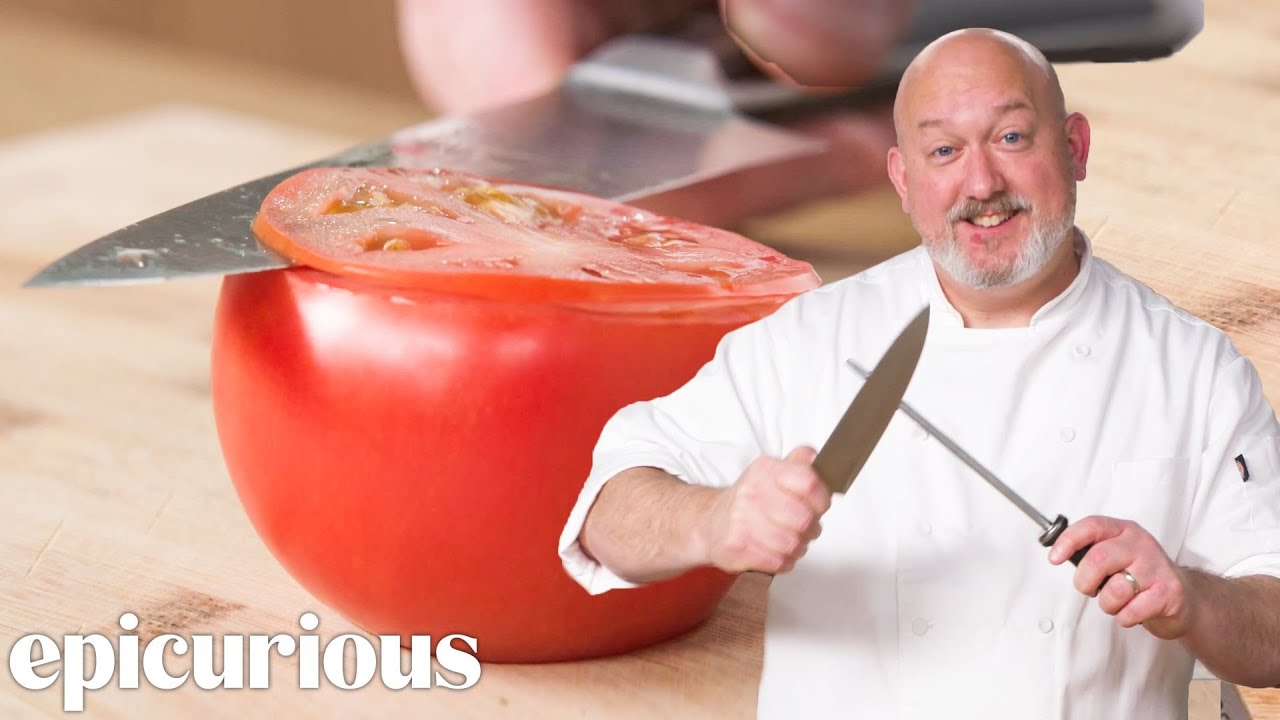
I'm Frank Proto — professional chef and culinary instructor. And this is knife care 101. Let me show you how to sharpen your knives, maintain them, and stay safe while using them.
Grandma might have sharpened her knives by rubbing two together. That doesn't work. Here's the right way.
Sharp knives aren't just about precision — they're about safety. Dull knives are dangerous because you have to push harder, and the more pressure you use, the more likely you are to slip and cut yourself. A sharp knife gives you clean cuts and helps your food cook evenly. Spending about 20 minutes every few months sharpening your knives makes all the difference.
I test my knives by turning the blade over and lightly running my thumb across it. If it's sharp, you'll feel it drag on your fingerprint — a little tug. If it's dull, it'll feel like running over a smooth bump.
You can also hear the difference. Cut a scallion with a sharp knife and you'll barely hear a whisper. With a dull knife, it's much louder because you're crushing the scallion before cutting it. You'll also see more moisture on your cutting board from the crushed cells. And you'll notice tearing instead of clean slices.
With a sharp knife, you can get paper-thin slices that are impossible with a dull blade.
Method 1: Water Stone (My Favorite)
There are two types of sharpening stones: oil stones and water stones. Oil stones require mineral oil that won't go rancid, but they get sticky and gummy. I find water stones easier to maintain.
What you need:
- A water stone (I use one with 1000 grit on one side and 6000 grit on the other)
- Cool water
- A wet towel (to keep the stone from sliding)
How to do it:
- Soak your water stone for about 30 minutes. You'll see bubbles — that means it's absorbing water. The stone is ready when the bubbles stop.
- The 1000 grit (rough side) gives your blade its shape. The 6000 grit (smooth side) gives it that sharp edge. Always start with the rough side.
- Place the stone in front of you, facing away. Put a wet towel underneath to keep it from sliding.
- Find your angle. A 90-degree angle to the stone, cut in half is 45, cut in half again is about 22.5 degrees. That's the angle I use. If you're a beginner, you can use an angle guide that slides onto the back of the knife. I don't use one because I'll lose it, but they work fine.
- Keep the stone wet. Use your right hand to push down on the blade, with your fingers applying pressure too — about 3-4 pounds. If you don't know what that feels like, grab a kitchen scale and practice.
- Start at the tip, push the knife away from you, turn it over, and pull it toward you. You'll see particles on the stone — that's metal from the knife being worn away.
- When you see particles, add more water and keep going. Use the rough side until you start to feel the blade getting sharp, then flip the stone over and repeat on the fine side.
- Once you're done, run the knife over a honing steel to tune up the edge.
Rating on the Franco-meter: 5 out of 5. It takes some practice, but it's worth it.
What's the Deal with Honing Steels?
That steel rod in your kitchen? It's not a sharpener. It's a honing steel. Every 10-15 minutes of prepping, run your knife over it. It keeps your blade tuned up between sharpenings.
Your blade has micro-serrations that get twisted out of alignment as you cut. Running it over the steel lines them back up. If your knife is already dull, running it over the steel for a month won't make it sharp.
To use it: start at the same angle you sharpened at, start at the bottom of the knife, and run it over and down. Keep going until the edge feels sharp. Some people prefer to hone away from their body or set the steel on a table and hone straight down.
Honing: 5 out of 5. Super important.
What About Serrated Knives?
Serrated knives are hard to sharpen. Most cooks don't even try — when they get dull, they recycle them. What I do is hone them more often while they're still sharp. Get between the serrations at your sharpening angle, then run the flat side over the steel. It doesn't sharpen, but it keeps the knife in tune.
Method 2: Manual Sharpener
This has two ceramic or metal blades inside that you drag your knife through. I only use this with cheaper knives.
To use it: hold it firmly (they usually have sticky rubber feet), and drag the knife straight through — coarse side first, then fine.
The problem? You'll see metal shavings. I don't want metal shavings in my food. It also gives you an okay sharpness that doesn't last long, so you're constantly re-sharpening.
Franco-meter: 2 out of 5. Not the best way to maintain your knives.
Method 3: Electric Sharpener
These have two abrasive wheels that spin fast. My concern is that the friction heats up the knife and ruins its temper — the heat treatment that keeps knives flexible and helps them hold an edge.
To use it: turn it on, start at the bottom, and pull the knife through. Some models shut off when they're done.
The sound is horrible. Like a Mad Max orchestra. And when it slows down, it sounds like it's just dulling the knife.
Franco-meter: 0 out of 5. If someone put my good knives through this, we'd have a problem. Don't come to my house and do that.
Method 4: The Bottom of a Plate
I've seen cooks in restaurants do this. It's not really sharpening — it's honing. You need the unglazed portion of the plate. If the whole plate is glazed, it won't work.
It might work for you, it might not. The unglazed ceramic is probably around 6000 grit. I can feel the knife getting a little sharper.
Franco-meter: 3 to 3.5 out of 5.
Proper Use and Safety
Use the right tool for the job. Don't use a chef's knife to peel things — it's inefficient and dangerous. Don't open cans or chop bones with a fine blade. That's what cleavers and can openers are for.
Watch your cutting surface. Never use glass or metal cutting boards. Hard surfaces dull your knife fast. Stick with plastic, rubber, bamboo, or wood.
Stop your board from sliding. Put a wet paper towel under your cutting board. It'll hold firm.
Cleaning Your Knives
Never put knives in the dishwasher. The heat ruins the temper and your knives won't hold an edge.
Never put knives in a sudsy sink. If I drop a knife in soapy water and walk away, someone could reach in and get cut. Knives go on the side, get washed by hand, and get put away immediately.
Here's how I clean mine: warm soapy water, a sponge. Hold the knife away from you. Don't run the sponge along the blade — it'll cut through the sponge. Clean the top of the blade and the sides. Always stay focused. Dry immediately to prevent rust.
Storing Your Knives
Bad storage = dents, chips, and dull edges. Don't throw knives in a drawer where they'll clatter around and beat each other up.
Knife block: Works well, easy access. Takes up counter space.
Magnetic strip: Hangs on the wall. Knives stick to it, stay safe, don't bang into each other.
Knife roll: For when you're on the go. Heavy duty canvas with individual pockets so knives don't touch. Compact, easy, grab-and-go.
Remember: dull knives are dangerous knives. Dull knives suck. Keep your knives sharp — or I'm coming to your house to sharpen them for you. People are going to call me on that one.