What You'll Need
Here's how I tap into my car's fuse box for a dashcam hardwire kit. If you've seen my other videos, you know a typical three-lead kit needs two power sources and a ground. The trick is figuring out which fuse gives you accessory power (red wire, only on when the car is on) and which gives you battery power (yellow wire, always on). Here's exactly how I find those spots.
- A hardwire kit with three leads (red, yellow, and a ground ring terminal)
- A multimeter or a simple 12V test light
- Fuse taps (one for each circuit you're tapping)
- Zip ties
- A trim tool or flathead screwdriver
- A socket set for ground bolts
Step-by-Step Guide
1. Check the Fuse Box Diagram
First, pop open your fuse box and find the diagram. Look for fuses that are already empty slots — those are ideal. But in many cars, those empty slots aren't actually connected to anything. If they're dead, you'll have to tap into an existing fuse.
2. Pick Your Fuses Carefully
Don't touch anything critical. I avoid these at all costs:
- PCM (engine computer)
- ABS (brakes)
- SRS (airbags)
- BCM or Cluster BCM (body control module and speedometer)
- Cruise control
What I look for instead: the cigarette lighter or auxiliary port for accessory power, and anything with "memory" (like power mirrors or radio presets) for constant battery power. In my car, I used the cigarette lighter fuse for ACC and the power mirror memory fuse for BAT.
3. Test Your Picks
Connect your test light or multimeter to a good ground — I found a bolt nearby. Then touch the probe to the metal contacts on top of each fuse you're considering.
- For the cigarette lighter fuse: no power with the car off. Turn the car to accessory position — now you have power. That's your ACC source.
- For the power mirror fuse: power even with the car completely off. That's your BAT source.
4. Install the Fuse Taps
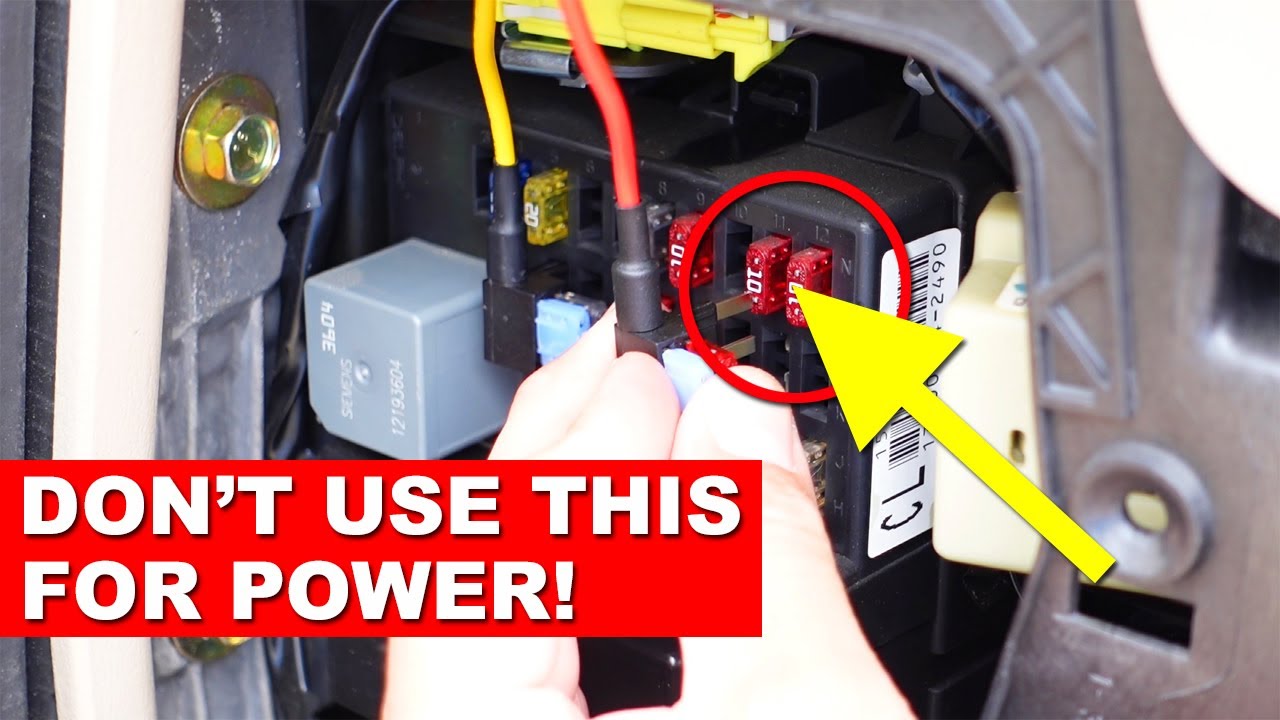
Pull out the fuse you're using. Insert it into the bottom slot of the fuse tap. Now check which side of the fuse tap has power — touch the top contact, then the bottom contact. One side will have power, the other won't.
The outside blade of the fuse tap needs to go into the powered side of the fuse slot. On my fuse box, that meant installing the tap with the outside blade facing down. If you get it backwards, the circuit won't work.
5. Connect Your Wires
Now just plug in the fuse taps. The yellow wire from my kit goes to the battery power tap, and the red wire goes to the accessory power tap. But check your kit's labels — some kits swap those colors. Read the manual.
6. Ground It
Find a bare metal bolt near the fuse box. Loosen it, slide the ring terminal of your ground wire under it, and tighten it back down. Done.
7. Tidy Up
Zip tie any loose cables and close the fuse box.
What to Watch Out For
Newer cars are sensitive to aftermarket electronics. I've seen stories of people hardwiring radar detectors into C8 Corvettes and frying the backup camera — warranty voided. If you're not sure, look up your car on forums and see what fuses other owners have used successfully. Or hire an installer who's done it before.
The safest bet is always an empty fuse slot, but if you have to share one, avoid anything critical. A good rule: don't tap into the airbag, the engine computer, or the brake system. Everything else is fair game if you check first.