What You’ll Need
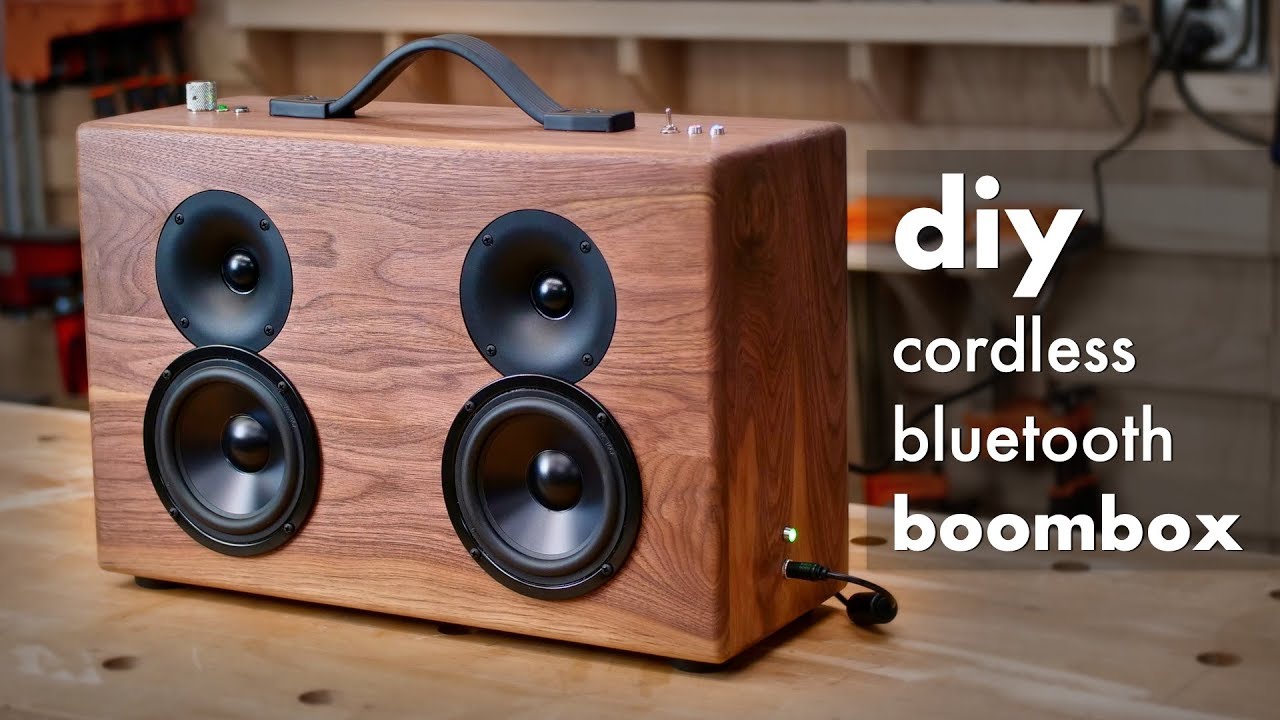
I’ve wanted to build a Bluetooth boombox for years. Not one of those little plastic boxes, but something that looks as good as it sounds. This one’s made from solid walnut, runs on battery power, and uses the C-Note speaker kit from Parts Express. It sounds amazing, and honestly, I’m still surprised it came out this clean for my first speaker build.
Let me show you how I put it together.
Wood & Materials
- Solid walnut (6/4 or 1.5” thick, resawn to 1/2”)
- Baltic birch plywood (for center divider)
- C-Note speaker kit (Parts Express) — includes woofers, tweeters, crossovers, MDF enclosures
- 1/2” sound-damping foam (peel-and-stick)
- Wood glue, CA glue
- Wipe-on polyurethane
- Spray polyurethane (for inside)
- 1” screws, 3/4” black screws
- Rubber feet
- Carrying handle
- Switches, LEDs, ports, power jack
- Crimp connectors, speaker wire
Tools
- Table saw, miter saw, bandsaw, jointer, planer
- Router table with flush trim bit and 3/8” round-over bit
- X-Carve or CNC (optional — can use templates)
- Forstner bits, caliper, drill
- Soldering iron (I used the Burnsomatic ST-500 cordless)
- Strap clamps, corner clamps
- Spokeshave, sandpaper (up to 180 grit)
Step 1: Prepare the Walnut
I started with 6/4 walnut (1.5” thick) and wanted my final boards to be 1/2” thick. First, I broke down the rough lumber on the miter saw, then squared everything up on the jointer, planer, and table saw.
To resaw the boards, I used the table saw for the bulk of the cut. I marked the center of each board with a marking gauge, set the fence so the blade would pass through the middle, and made multiple passes — flipping the board each time so the same face stayed against the fence. I raised the blade until about 3/4” of material remained in the middle, then finished the cut on the bandsaw.
After resawing, I ran the boards through the planer to remove that center ridge and get them flat.
Step 2: Glue Up the Panels
Before gluing, I trimmed off any sapwood or areas I didn’t like the look of. I arranged the boards in the best orientation and labeled them so I wouldn’t mix them up during glue-up. To get perfect glue joints, I used a trick from my buddy Jay Bates: joint two mating boards with opposite faces against the fence. That way, any tiny error in the fence squareness cancels out, and you get a flat panel.
I glued up the panels without any alignment tools — just clamps on the ends of the seams to keep everything lined up. After a few hours, I scraped off the glue and ran the panels through the planer again.
Step 3: Cut the Mitered Frame
I ripped the top, bottom, and side panels to final width on the table saw. Then I set the blade to 45 degrees and cut miters on both ends of each board. I used a stop block on the miter gauge so all the panels came out the same length.
I glued up the box with strap clamps and corner clamps. Ended up with a perfectly square box and no gaps — always nice.
Step 4: Front and Back Panels
I cut the front and back panels to size on the miter saw based on the final frame dimensions.
For the speaker holes, I used the X-Carve to cut them. I modeled the layout in Easel (Inventables’ free CAM software), did a test cut on plywood, and then cut the final walnut panel. Took about 13 minutes with a 1/4” bit. After cutting, I broke the tabs and cleaned up the edges with a spokeshave and sandpaper.
I wanted the panels to sit recessed into the frame, so I cut a 1/2” wide by 1/8” deep rabbet on all four edges of each panel — long edges first to prevent blowout.
I glued the front panel onto the frame with plenty of glue and clamps. Speaker boxes need to be airtight, so don’t skimp here.
Step 5: Reinforce the Corners
I wanted a heavy round-over on all the corners — that meant removing a lot of material. To keep the box strong, I glued wooden blocks into the inside corners using a mix of CA glue (holds instantly) and wood glue (for long-term strength). I also added blocks to the top and bottom panels — those are where the screws for the removable back panel will go.
I almost forgot the center divider. I cut it from 1/2” Baltic birch plywood, notched the top and bottom blocks to make room, and glued it in place. Again, plenty of glue for an airtight seal.
I also cut a rabbet in the center of the back panel so it wouldn’t interfere with the divider. Then I clamped the back panel, pre-drilled and countersunk holes, and screwed it on with 1” screws.
Step 6: Shape and Finish the Box
I cleaned up any overhanging edges on the front and back panels with a flush trim bit on the router table. Then I swapped to a 3/8” radius round-over bit and ran it over all the edges. That heavy round-over completely transforms the look — it makes the walnut feel premium.
I sanded everything up to 180 grit.
For the finish, I used wipe-on polyurethane — three coats, letting each dry about six hours between coats. It really pops the walnut grain. I also sealed the inside of the cabinet with spray polyurethane to help reduce seasonal expansion and contraction. Not necessary if you use MDF or plywood, but I figured it couldn’t hurt.
Step 7: The Electronics (My First Time Soldering)
This was the part I was nervous about. I’d never soldered before, and the C-Note kit has a ton of connections. The crossovers split the audio signal — high frequencies to the tweeters, low frequencies to the woofers. The kit includes very detailed instructions.
I used the Burnsomatic ST-500 cordless soldering iron and ST-2200T detail torch (both butane-powered, so no outlet needed). I also used Burnsomatic rosin-core solder — no flux required.
I soldered the crossover components together, added wiring to connect them to the speakers and the amp, and soldered the power jack to the amp board leads. Then I stripped the speaker wire ends and added crimp connectors for easy speaker attachment.
Step 8: Drill All the Holes
This was tedious. Every component — switches, LEDs, ports, handle — had different thread sizes. I used a caliper to find the correct drill bit for each one. Many parts only had about 1/4” of threaded length, so I had to recess the holes with a Forstner bit from the inside to let the threads protrude through.
I added rubber feet to the bottom to stop rattling.
For the ports on the bottom, I needed a 1-3/4” hole. I didn’t own that size Forstner bit. So I drilled a 1-1/4” hole, used the X-Carve to cut a template, then mounted a flush trim bit in the router table, attached the template to the cabinet with double-stick tape, and routed the hole. Saved me $20 and worked perfectly.
Step 9: Final Assembly
I added 1/2” sound-damping foam to all inside faces except the front baffle. Peel-and-stick foam — just cut to size with scissors, cutting around the holes.
I mounted the crossovers and amp board to the center divider with screws. I used a round rasp to cut a groove in the divider so cables could pass from one side to the other.
Then I installed all the switches, LEDs, handle, rubber feet, and ports. Attached the back panel. Dropped in the speakers.
And that was it.
How It Sounds
I’m a bit of an audiophile — I own expensive headphones and speakers. This thing genuinely impressed me, especially for my first speaker build. It’s loud, clear, and the walnut cabinet looks incredible.
If you want more detail on the electronics or a full parts list, I’ve got a write-up on my website with links to everything. And if you build one, let me know how it goes.