What You'll Need
I've been messing around with ESP32 boards for a while now, and honestly, they're probably the best bang for your buck if you're getting into microcontroller projects. Built-in WiFi and Bluetooth for under $10? Yes please.
Here's a list of 12 beginner-friendly projects I found that cover everything from home automation to crypto tracking. No fluff, just the good stuff.
- ESP32 development board (any variant works)
- Breadboard and jumper wires
- Basic electronic components (resistors, LEDs, etc.)
- Specific modules depending on the project (listed below)
1. Smart Health Monitor
Measures heart rate and oxygen saturation. You place your finger on an oximeter sensor connected to the ESP32, and it updates the readings to a web server. You can view the data from any device with internet access. No extra display needed — just the sensor and the board.
Materials: ESP32, MAX30100 or similar oximeter sensor
2. AWS Home Automation (Advanced)
This one uses a 4-channel relay module to control home appliances. Power the module with a 5V adapter through a voltage regulator. Four GPIO pins on the ESP32 act as outputs. Select the corresponding topic on AWS, change the status to 1 to turn a lamp on, 0 to turn it off. Serial monitor shows you what's happening.
Materials: ESP32, 4-channel relay module, 5V power adapter, home appliances
3. AWS LED Control (Beginner)
Start simple before jumping into relays. Connect an LED to GPIO 23 with a 560-ohm resistor. Create a thing and policy on the AWS Management Console. Set LED control to 1 and it glows. Set it to 0 and it stops. You can do this from anywhere in the world.
Materials: ESP32, LED, 560-ohm resistor
4. ESP32-CAM Google Drive Uploader
The ESP32-CAM module captures images and uploads them directly to Google Drive using the Google Drive API. You need a specific client ID and password to access the folder. Set up a project on the Google Developer Console, enable the Drive API, create a client ID, paste the folder link into the Python code. Only people with login credentials can view the images and videos.
Materials: ESP32-CAM module, Google account
5. LoRa Messaging Platform
WiFi and Bluetooth don't work well over long distances. LoRa modules do. This setup uses two ESP32 boards with LoRa modules. Press a button on the first board, and the second board receives the message — viewable on the serial monitor. The onboard LED flashes for 2 seconds when a message arrives.
Materials: 2x ESP32, 2x LoRa modules, push button
6. Bidirectional People Counter
Two ultrasonic sensor modules track people entering or leaving a room. OLED displays on a perfboard show the count and current number of people inside. The data goes to the cloud so you can track it from any smart device. When someone's inside, the lights turn on automatically. Empty room? Lights off. Smart energy saving.
Materials: ESP32, 2x HC-SR04 ultrasonic sensors, OLED display, relay module
7. Social Media Follower Tracker
Tracks follower changes from your social media accounts. Fetches data and gathers it on a web application. When you gain or lose followers, a green or red LED lights up along with a buzzer sound. View the follower count on an LCD screen. This is a prototype — you can modify it for a bigger display. Press a push button to close the notification.
Materials: ESP32, LCD display, green and red LEDs, buzzer, push button
8. Stepper Motor Music Player
Yes, you can play music with motors. Nema 17 stepper motors step forward and backward at specific frequencies. By changing the step angle, you match the notes of a song. LEDs show the motor status. It sounds weird, but it works.
Materials: ESP32, Nema 17 stepper motors, stepper motor drivers, LEDs
9. Movie on an OLED Display
Darwin took all the frames from movie clips, converted them to the size of a 0.96-inch OLED display, stored the file on an SD card, and had the ESP32 read and send the frames to the screen. Lights out, sound on. It's tiny but it works.
Materials: ESP32, 0.96-inch OLED display, SD card module, SD card
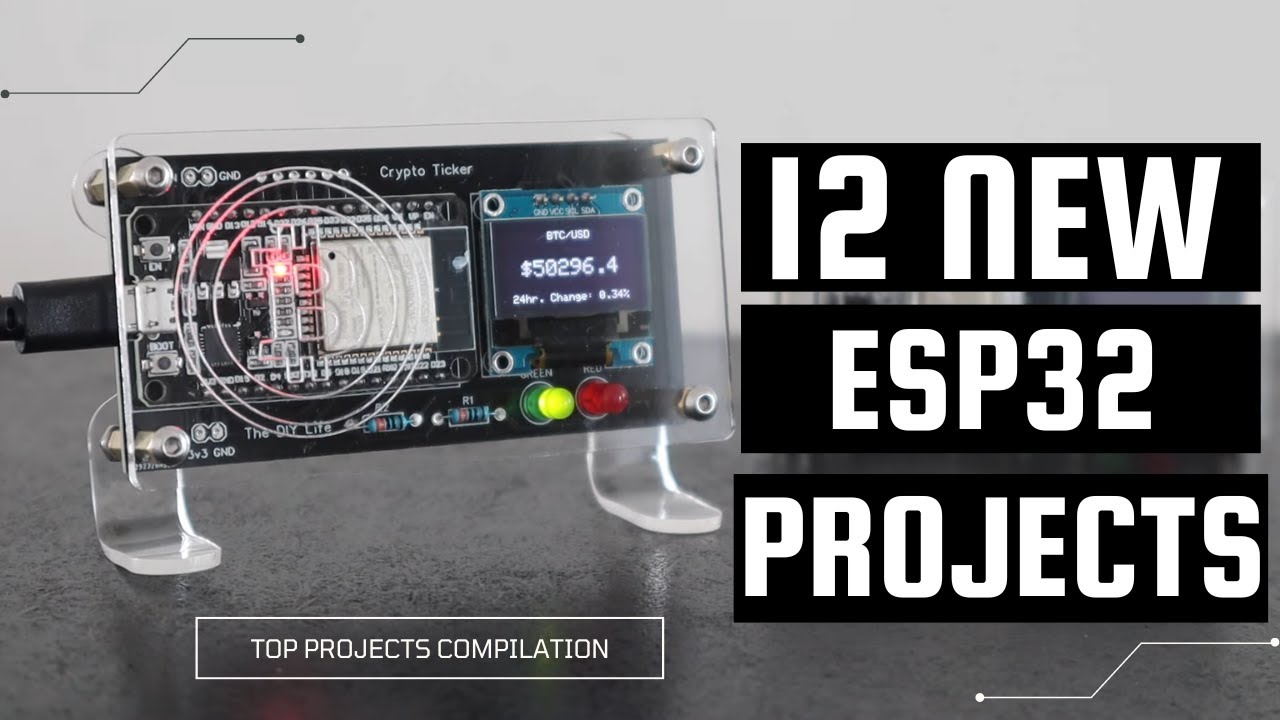
10. Crypto Price Ticker
Displays the price of any cryptocurrency with an available API. Shows the percentage change from the previous day's closing price. The LED underneath lights up green or red depending on whether the price went up or down. Updates every 15 minutes because the ESP32 goes into deep sleep mode between updates to save power.
Materials: ESP32, OLED display, LED
11. Precision Voltmeter
Most microcontrollers have built-in ADCs, but they're not that precise. This uses a 16-bit external ADC that communicates with the ESP32 via I2C. The voltage reference is set to 4.096V. No voltage divider circuit here — measuring voltages above the reference can damage the ADC or ESP32. Use this for precise voltage readings of batteries or solar kits.
Materials: ESP32, ADS1115 16-bit ADC module, voltage source
12. Fan Speed Controller
Uses a TTGO display and a rotary encoder. Press the encoder to turn the fan on or off. Turn it to control the speed. The display shows the RPM. As you rotate the shaft, pulses get counted by the microcontroller. You can even use an optical mouse instead of a rotary encoder.
Materials: ESP32 with TTGO display, rotary encoder, fan